Your Cart is Empty
Shipping is free on orders over €60!
Shipping is free on orders over €60!

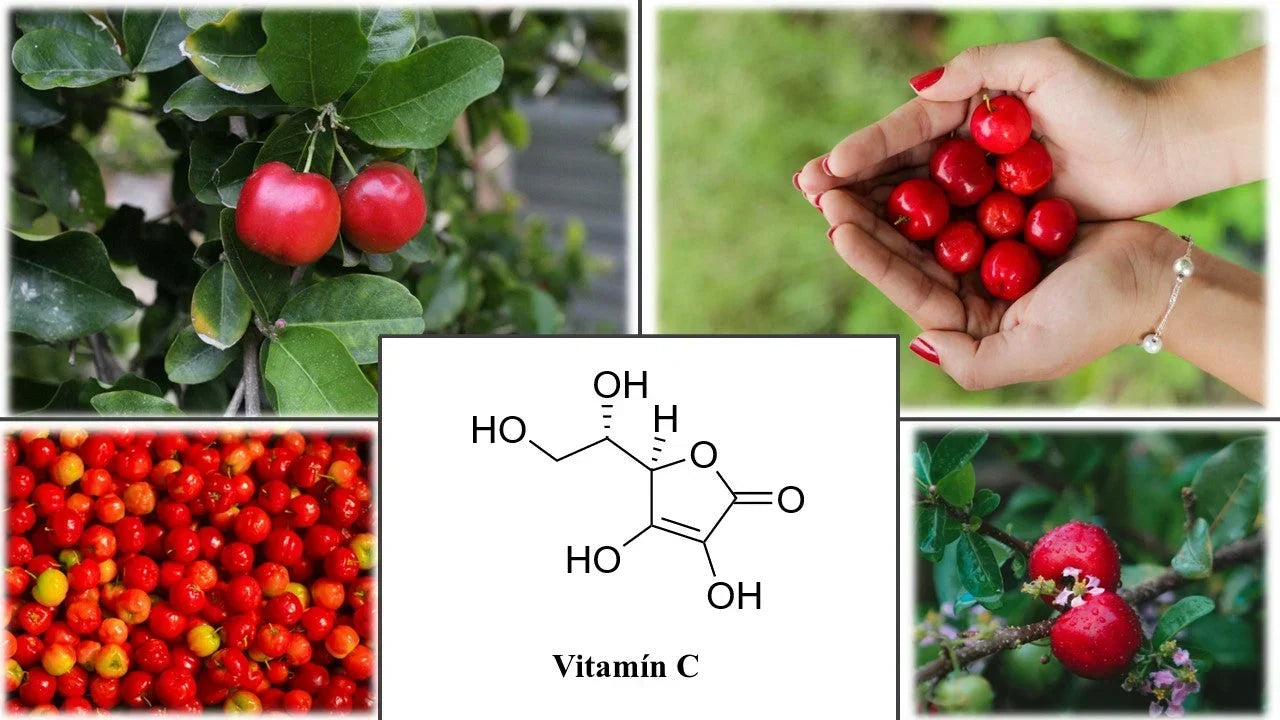
Acerola (Malpighia emarginata DC.; syn. Malpighia glabra L.), often referred to as Barbados cherry or West Indian cherry, is a tropical evergreen shrub or small tree belonging to the Malpighiaceae family (Carrington and King, 2002). It has a densely branched growth habit and a short trunk; young twigs may be finely hairy, while older leaves are smooth and glossy. The leaves are simple and elliptical, approximately two to eight centimetres long, and arranged in opposite pairs along the branches (Delva and Schneider, 2013; Prakash and Baskaran, 2018). The flowers are small, five-petalled, pale to deep pink, and often grouped in axillary inflorescences. They develop into round, red drupes approximately one to three centimetres in diameter, usually with three compartments and weighing about three to five grams. Ripe fruits are glossy red (Fig. 1), very juicy, and predominantly sour to astringent in flavour; only some cultivars are sweeter. A characteristic feature of acerola is the very short shelf life of its fresh fruit, which often lasts only two to three days at room temperature (Carrington and King, 2002; Delva and Schneider, 2013; Prakash and Baskaran, 2018). For this reason, acerola is rarely sold as fresh fruit and is much more commonly processed into juices, purées, concentrates, and especially freeze-dried powders used in dietary supplements and functional foods. Acerola is native to tropical regions of the Caribbean, Central America, and South America, ranging from southern Texas and Mexico through the Caribbean islands to Brazil. However, cultivation has spread to other regions with suitable climates, including Southeast Asia, India, Africa, and Australia. Brazil is among the most important acerola producers, and in practice, emphasis is placed on rapidly stabilising the fruit after harvest (Carrington and King, 2002; Delva and Schneider, 2013). The fruit can be harvested repeatedly throughout the year and is often immediately frozen or processed to minimise losses of sensitive compounds and preserve its nutritional value. In the traditional folk medicine of Latin America and the Caribbean, acerola was used primarily for colds and feverish conditions and as a supportive remedy during recovery. This use is mainly associated with its exceptionally high vitamin C content and the expected support of immune function. In some areas, ethnomedicinal applications also included diarrhoea, dysentery, and coughs, or minor injuries, where an astringent effect has been described (Delva and Schneider, 2013; Prakash and Baskaran, 2018). Acerola also has technological applications in the food industry, where both the fruit and processing by-products are being investigated as sources of antioxidants and functional ingredients for food applications (Delva and Schneider, 2013; Miskinis et al., 2023).
The chemical composition of acerola is characterised by a combination of very high ascorbic acid content and a broad spectrum of polyphenols and other antioxidants (Fig. 1;Laurindo et al., 2024). Vitamin C content varies considerably and depends on genotype, ripeness, climatic conditions, and processing methods (Cordeiro et al., 2026; Vilvert et al., 2024). The literature most commonly reports approximately 1,500–4,500 mg of vitamin C per 100 g of fresh weight, placing acerola among the richest known natural sources of this vitamin (Prakash and Baskaran, 2018). As ripening progresses, the content of ascorbate and some polyphenols typically decreases, while the proportion of sugars increases. For certain pigments, the lipophilic fraction, particularly carotenoids, may become increasingly important (Corrêa et al., 2017; Xu et al., 2020). In addition to vitamin C, acerola contains flavonoids, including flavonols and their glycosides, among which rutin and other quercetin derivatives are frequently mentioned (Miskinis et al., 2023; Vilvert et al., 2024). Phenolic acids are also present, including ferulic, p-coumaric, and chlorogenic acids (Coyago-Cruz et al., 2025). Anthocyanins play a role in coloured varieties; cyanidin-3-O-glucoside is often mentioned and, together with other pigments, contributes to the red colour of the fruit (Vilvert et al., 2024). The lipophilic fraction contains carotenoids such as β-carotene, lutein, and β-cryptoxanthin (Prakash and Baskaran, 2018). The fruit also contains minerals, pectin, and other vitamins, including vitamins A and E and certain B vitamins, with the concentrations of individual components varying according to ripeness and preservation methods. From a practical perspective, acerola is best viewed as a complex antioxidant matrix in which not only ascorbate itself but also its functional interaction with polyphenols and carotenoids probably plays a role (Cordeiro et al., 2026; Prakash and Baskaran, 2018; Vilvert et al., 2024; Xu et al., 2020).

Figure 1.Acerola fruit (Malpighia emarginata) as a rich source of vitamin C.
The biological effects of acerola are usually explained by a combination of direct antioxidant activity and indirect modulation of cellular pathways associated with inflammation and oxidative burden (Olędzki and Harasym, 2024; Wu et al., 2025; Zhu et al., 2025). Vitamin C, polyphenols, and carotenoids can directly neutralise reactive oxygen species and reduce oxidative stress, which contributes to the development of many chronic diseases. Preclinical studies also describe anti-inflammatory effects of extracts from both the fruit and processing by-products, such as skins, seeds, and pomace (Batista et al., 2023; Laurindo et al., 2024; Olędzki and Harasym, 2024). In terms of mechanism of action, research discusses the influence of polyphenols on the regulation of signalling pathways associated with pro-inflammatory cytokine production and the activity of transcription factors, typically NF-κB, as well as their effects on the expression and activity of endogenous antioxidant enzymes (Alvarez-Suarez et al., 2017; Zhu et al., 2025). From a practical perspective, it is useful to distinguish between effects arising mainly from vitamin C supplementation and those in which synergy between ascorbate and polyphenols probably plays a role. Polyphenols may contribute to the regeneration of oxidised ascorbate and prolong its antioxidant activity while also influencing inflammatory processes at the level of cellular signalling (Wu et al., 2025; Zhu et al., 2025). In terms of applications, immune function support is most frequently discussed, followed by potential cardiometabolic benefits associated with endothelial protection and effects on low-grade inflammation and certain metabolic markers. The strength of the evidence varies according to the product form, dose, and target population (Vítek et al., 2025). Experimental models also suggest a hepatoprotective effect, which is generally associated with reductions in markers of liver damage and increases in antioxidant capacity (Batista et al., 2023; El-Hawary et al., 2020; Olędzki and Harasym, 2024). In cosmetics and dermatology, acerola is used mainly because of vitamin C’s role in collagen synthesis and its antioxidant and photoprotective properties, to which carotenoids and polyphenols may also contribute (Alvarez-Suarez et al., 2017; Calvo et al., 2024; Michalak et al., 2021).
Acerola is most commonly taken as a dried powder, freeze-dried preparation, or extract, or as an ingredient in blends intended to support immunity (Bourafai-Aziez et al., 2022; Laurindo et al., 2024). Dosage is usually based on the product’s declared vitamin C content, often within a range of approximately 250–1,000 mg of vitamin C daily. In practice, however, it is important to bear in mind that ascorbate content can vary substantially between products and batches (Bourafai-Aziez et al., 2022; Garcia et al., 2020). Acerola is generally considered well tolerated. Adverse effects are typically associated with higher vitamin C doses and the acidity of the product, which may cause gastrointestinal discomfort, heartburn, nausea, or diarrhoea. In predisposed individuals, a persistently high ascorbate intake is theoretically associated with an increased oxalate burden and a higher risk of kidney stone formation. For sensitive individuals, it is therefore practical to take acerola with food and avoid prolonged excessive vitamin C intake (Han et al., 2015). Caution is appropriate for pregnant and breastfeeding women because of the limited clinical data, and ordinary dietary amounts are generally recommended rather than extracts.
Alternative or complementary sources of vitamin C and polyphenols frequently mentioned include rosehip (Kumar et al., 2025), sea buckthorn (Hippophae) (Chen et al., 2024), camu-camu (Myrciaria dubia) (Maqsood et al., 2025), and Kakadu plum (Terminalia ferdinandiana) (He et al., 2023). In practice, acerola is commonly combined with flavonoids such as rutin or hesperidin (Bourafai-Aziez et al., 2022; Omar et al., 2022), and with extracts that have an immunomodulatory or adaptogenic profile, such as ginseng or purple coneflower (echinacea), to strengthen the antioxidant and immune-related rationale for use (Gancitano et al., 2024; Valdés-González et al., 2023). The choice between individual sources should consider not only the declared vitamin C content but also processing methods, the stability of active compounds, stomach sensitivity, and any individual limitations, such as a predisposition to urinary stones.
Written for Kratom World by:
Ing. Matěj Malík, Ph.D.
Research Scientist, Postdoctoral Researcher
Faculty of Agrobiology, Food and Natural Resources, Czech University of Life Sciences Prague
Department of Agroenvironmental Chemistry and Plant Nutrition

References