Your Cart is Empty
Shipping is free on orders over €60!
Shipping is free on orders over €60!

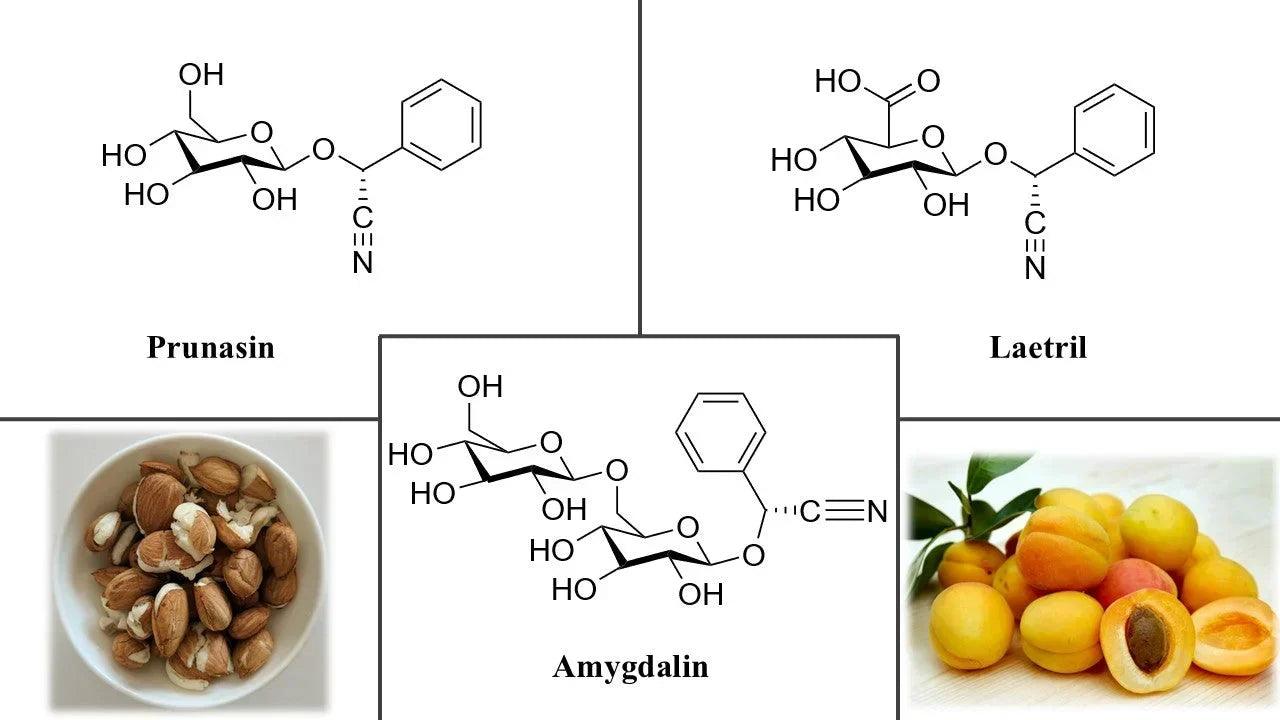
Amygdalin is a naturally occurring cyanogenic glycoside, first isolated in the 19th century from bitter almonds (the almond tree, Prunus dulcis). It is found mainly in the seeds of stone fruits, especially apricots, but also in peaches, plums, apples, and cherries (Thodberg et al., 2018). Chemically, it is D-mandelonitrile-β-D-gentiobioside (Fig. 1). In the body, it is gradually hydrolyzed into benzaldehyde, glucose, and hydrogen cyanide (HCN) (He et al., 2020). Amygdalin is often confused with its semisynthetic form, “laetrile” (a commercial name). Laetrile was first synthesized in 1952 by Ernst T. Krebs Jr., who intended this modification (the attachment of one glucose molecule) to increase its effectiveness and named it vitamin B17 (He et al., 2020; Milazzo et al., 2015). Amygdalin and laetrile were popular in the 1960s and 1970s as purported cancer remedies. It is estimated that approximately 70,000 patients in the United States had undergone laetrile treatment by 1978, before the authorities banned its importation. However, it remained available in some countries, for example in Mexico and in certain US states for terminally ill patients (Milazzo et al., 2015). In traditional Chinese medicine, ground bitter apricot kernels (“xing ren”) have been used for centuries, though not primarily against cancer, but mainly to treat respiratory problems. They are attributed with effects that relieve cough and asthma (expectorant and antitussive activity), as well as a laxative effect. Decoctions of bitter kernels were administered in small doses for bronchitis, asthma, whooping cough, or constipation. Traditional Eastern medicine regarded these seeds as bitter and mildly toxic, so they were used cautiously and often after heat treatment (roasting or boiling) to reduce toxicity (Tang et al., 2024). In addition to pulmonary diseases, the ethnomedicine of various cultures also included the use of apricot kernels for certain skin conditions, such as vitiligo or leprosy in China, and for pain (He et al., 2020). The widely circulated claim that cancer is exceptionally rare among the Hunza people, who consume large quantities of apricot kernels, is often mentioned by advocates of vitamin B17, but it is an unverified anecdote (Petersen and Markle, 1979).
Apricot kernels are rich in oil and protein and also contain cyanogenic glycosides, mainly amygdalin. The dry matter of bitter apricot kernels may consist of approximately 46–53% fat (oil composed predominantly of monounsaturated oleic acid and linoleic acid), around 25% protein, and approximately 10% carbohydrates and fiber (Akhone et al., 2022). Notable micronutrients include small amounts of vitamin E and various polyphenols, such as chlorogenic and caffeic acids, the flavonoids quercetin and rutin, and procyanidins, which contribute to antioxidant activity (Akhone et al., 2022; Cheaib et al., 2018). Amygdalin itself accounts for a variable percentage of the kernel mass, depending on the apricot variety. In bitter wild cultivars, its concentration may reach around 5% (up to approximately 5.5 g per 100 g of kernels), whereas sweet varieties of cultivated apricots contain amounts an order of magnitude lower — tenths of a percent or less (Femenia et al., 1995). Analyses report a typical amygdalin content in bitter apricot kernels of around 20–30 mg per 1 g of dry matter (Alpaslan and Hayta, 2006). In addition to amygdalin, kernels usually contain smaller amounts of the related monoglycoside prunasin (mandelonitrile-β-glucoside) (Fig. 1), which is effectively “half” of the amygdalin molecule. When cells are disrupted, for example by chewing a kernel, the enzyme β-glucosidase gradually breaks down amygdalin through prunasin into benzaldehyde and HCN. Benzaldehyde gives crushed bitter almonds and apricot kernels their characteristic bitter-almond aroma (Jaszczak-Wilke et al., 2021); hydrogen cyanide is a highly poisonous gas, although the body can detoxify it to a certain extent by converting it into thiocyanate (Jaszczak-Wilke et al., 2021). In addition to amygdalin, apricot kernels contain other substances worth mentioning, such as β-sitosterol and other phytosterols in the oil fraction, as well as minerals including magnesium, phosphorus, potassium, and iron (Akhone et al., 2022).

Figure 1. The apricot tree (Prunus armeniaca L.) and the cyanogenic glycosides characteristic of its seeds.
Amygdalin became known primarily for its purported anticancer effects, which led to its widespread use outside conventional medicine. The proposed mechanism of its antitumor action is based on the release of cyanide from the amygdalin molecule in the body, which is supposed to selectively destroy tumor cells (Carbone et al., 2025; Jaszczak-Wilke et al., 2021). Cyanide inhibits cytochrome c oxidase (complex IV) in the mitochondrial respiratory chain, blocking electron transfer to oxygen and bringing oxidative phosphorylation (ATP production) to a halt (Zuhra and Szabo, 2022). The result is a rapid collapse of cellular energy production and cell death. However, this effect is not selective (Carbone et al., 2025). Cyanide damages all cells in which it reaches a sufficient concentration, not just tumor cells. According to some authors, tumor cells may be more vulnerable because of a supposedly lower capacity to detoxify cyanide, for example through lower rhodanese activity, combined with higher activity of β-glucosidases, which can release cyanide from amygdalin. However, these hypotheses have not been conclusively demonstrated (Carbone et al., 2025; Greenberg, 1980; Jaszczak-Wilke et al., 2021). Nevertheless, in vitro experiments show that amygdalin can kill tumor cells under certain conditions, typically by inducing apoptosis (programmed cell death) or arresting the cell cycle (Spanoudaki et al., 2023). For example, some in vitro studies on breast cancer cell lines reported an increase in the ratio of the proapoptotic protein Bax to the antiapoptotic protein BCL-2 and increased caspase-3 activity following exposure to amygdalin, which were associated with the induction of apoptosis (Lee and Moon, 2016; Zielińska et al., 2022). Similarly, cellular models of colorectal cancer, non-small cell lung cancer, and prostate cancer have shown effects of amygdalin associated with the suppression of migration and invasiveness and the induction of apoptosis (Park et al., 2005; Qian et al., 2015; Spanoudaki et al., 2023). Some papers also suggest that amygdalin reduces the expression of cyclooxygenase-2 (COX-2) and inducible nitric oxide synthase (iNOS), although these findings come mainly from experimental models of inflammation rather than directly from tumor cells (Yang et al., 2007). Anti-inflammatory and antifibrotic effects of amygdalin have also been described outside oncology. In experimental models of pulmonary and renal fibrosis, amygdalin alleviated fibrotic changes and reduced selected markers of fibrosis (Guo et al., 2013; Jiao et al., 2023). Antitussive and antiasthmatic effects have also been reported, consistent with its traditional use for cough and shortness of breath. These effects have been demonstrated in animals: amygdalin reduced cough frequency and suppressed the inflammatory response and airway remodeling in asthma models (Cui et al., 2023; Miyagoshi et al., 1986). In addition, animal studies have suggested antiatherogenic effects (protection against hardening of the arteries) and antiulcer effects, with amygdalin administration reducing the formation of chemically induced gastric ulcers (Abdel-Gawad et al., 2023; Wang et al., 2020). However, it must be emphasized that the vast majority of these findings come from laboratory experiments. Overall, preclinical in vivo animal studies show no or only limited antitumor effects, and clinical studies in humans have not demonstrated an antitumor effect (Carbone et al., 2025; Milazzo et al., 2015). Claims of successful cancer treatment with amygdalin are based predominantly on individual case reports without control groups. Such reports alone do not allow a reliable assessment of efficacy or a distinction between a possible treatment effect and the spontaneous course of the disease, concurrent therapy, or a placebo effect. Clinical studies in humans are limited. The scientific literature describes two larger clinical studies from the United States in the early 1980s that evaluated amygdalin or laetrile in cancer patients. These studies, involving a total of 178 patients, did not demonstrate objective improvement in the course of the cancer, tumor regression, or prolonged survival compared with the expected course. Some patients reported a subjective reduction in pain, which may have been related to accompanying factors or the effects of certain metabolites (Moertel et al., 1981; Moertel et al., 1982). Systematic reviews conclude that there is no reliable evidence of the antitumor efficacy of amygdalin in humans, while the risk of serious adverse effects is documented (Carbone et al., 2025; Milazzo et al., 2015). In recent years, new in vitro studies have been published investigating potential cancer-preventive effects, meaning protection against tumor development. Experimental tests have also described antimutagenic or genoprotective effects of amygdalin, but these findings are preliminary and require confirmation in in vivo models and subsequently in clinical research (Erikel et al., 2023; Todorova et al., 2017).
It is estimated that a dose of 0.5 to 3.5 mg of cyanide per kg of body weight can be fatal to humans. The European Food Safety Authority (EFSA) established an acute reference dose (ARfD) for cyanide of 20 μg HCN equivalents/kg of body weight, which is 25 times lower than the lowest reported lethal dose. For a 70 kg adult, the ARfD corresponds to approximately 1.4 mg HCN. EFSA estimates that eating just three small raw apricot kernels (approximately 370 mg in total) in a single portion may exceed the safe threshold in an adult. In toddlers, even one small kernel may cause the safe level to be exceeded (EFSA, 2016). These estimates are consistent with reported cases: the medical literature describes acute poisoning in children and adults after consuming several apricot kernels or bitter almonds (Jaswal et al., 2018). Symptoms of cyanide poisoning include headache, confusion, flushing, nausea and vomiting, anxiety, weakness, and a drop in blood pressure; more severe cases involve shortness of breath, seizures, unconsciousness, and death from respiratory arrest. Chronic exposure to lower doses may be associated with insomnia, nervousness, joint pain, and general weakness, among other symptoms (EFSA, 2016; EFSA et al., 2019). The body can detoxify small amounts of cyanide by converting it into thiocyanate with the involvement of rhodanese and other sulfurtransferases, but the capacity of this mechanism is limited (Buonvino et al., 2022). Some sources state that detoxification may be slower when sulfur or certain cofactors are deficient, for example in marked vitamin B12 deficiency or when taking high doses of vitamin C (Jaswal et al., 2018). Cases of severe poisoning have also been described in cancer patients taking laetrile, particularly when larger quantities of kernels were consumed at the same time, sometimes requiring hospitalization. For these reasons, many countries have banned the sale of pure laetrile (Carbone et al., 2025). Dietary supplements have varying dosages, with approximately 20 mg of amygdalin per capsule often stated, roughly equivalent to one bitter kernel. Manufacturers generally recommend 1 to 2 capsules daily, which, if the dosage is followed and no additional amygdalin is consumed in food, should not exceed the acute reference dose for cyanide in an adult (EFSA, 2016; EFSA et al., 2019).
Numerous other plant substances are being studied for possible antitumor or supportive effects. Some show promising results in preclinical studies and are not associated with a risk of acute toxicity. However, it must be emphasized that their use is appropriate only as an adjunct to standard treatment and always after consultation with the treating physician.
Mistletoe extract (Viscum album) is among the most commonly used approaches in complementary oncology in Europe. Injectable preparations are used particularly in Germany and Switzerland, primarily to improve quality of life. Some clinical studies report fewer chemotherapy side effects, improved appetite, and relief from fatigue. Reviews and meta-analyses also suggest possible effects on certain clinical outcomes, but interpretation is limited by methodological differences and the quality of the available studies (Loef and Walach, 2020; Pelzer et al., 2022). Mistletoe is generally considered to have low toxicity and is authorized as a supportive treatment in some countries (PDQ Integrative and Board, 2002).
Curcuminoids from turmeric (Curcuma longa) are being intensively studied, particularly for their anti-inflammatory and antioxidant activity and potential antitumor mechanisms. In laboratory models, curcumin influences the growth of various types of tumor cells and affects numerous signaling pathways associated with tumor progression. Some animal models have also shown an effect on slowing tumor development (Akter et al., 2025; Ameer et al., 2024). Clinical studies in humans have so far produced inconclusive results, and the low bioavailability of curcumin is a significant limitation (Anand et al., 2007; Khosravi and Seifert, 2024).
Green tea (Camellia sinensis) contains polyphenols, particularly epigallocatechin gallate, which are being studied for possible chemopreventive effects. Effects on tumor cell proliferation have been described in in vitro experiments. Epidemiological studies, particularly in Asian populations, suggest a possible association between high green tea consumption and a lower incidence of certain cancers, but the findings are inconsistent and do not establish causality (Schulze et al., 2017; Yuan, 2013). Green tea is generally safe, although high doses may cause insomnia in sensitive individuals, and some concentrated extracts may adversely affect the liver (EFSA et al., 2018; Grajecki et al., 2022).
Resveratrol and other antioxidants from fruit and vegetables, such as quercetin or genistein, show effects in cellular models related to the regulation of inflammation, oxidative stress, and cell signaling, including pathways associated with apoptosis (Huminiecki, 2022; Pawłowski et al., 2024). Their clinical benefits in humans have not been conclusively demonstrated, although clinical trials are underway for selected indications (Joao et al., 2013; Pawłowski et al., 2024; Singh et al., 2019). These substances can also be obtained through a regular diet with low risk and potential benefits for cardiovascular health (Singh et al., 2019; Weber and Hopp, 2020).
Vitamin D is not a herbal preparation; nevertheless, adequate levels are associated with overall health and, in observational studies, with the prognosis of certain diseases, including selected cancers (Keum et al., 2019; Manson et al., 2020; Manson et al., 2019). Supplementation in individuals with a deficiency may help support immune function and general health and is usually safe when recommended doses are followed. However, it should not be regarded as a cancer treatment, but rather as a supportive measure within comprehensive care (Holick et al., 2011; Keum et al., 2019; Manson et al., 2019).
Written for Kratom World by:
Ing. Matěj Malík, Ph.D.
Research Scientist, Postdoctoral Researcher
Faculty of Agrobiology, Food and Natural Resources, Czech University of Life Sciences Prague
Department of Agroenvironmental Chemistry and Plant Nutrition

References